
























Quick Links
What are Home Loan Interest Rates?
- Home loan interest rate is the percentage at which additional funds are charged by a lender on the amount borrowed to purchase, construct or renovate a house.
- It is a key factor that determines your monthly EMIs and overall cost of credit repaid over the loan tenure.
- The home loan interest rate applicable depends on multiple factors such as credit score, loan amount, loan tenure, employment type (salaried or self-employed), income stability, and the lender’s internal risk assessment.
- Most home loans are linked to RBI-mandated external benchmarks like the repo rate.
Why Compare Home Loan Interest Rates on TFS?
- TFS shows curated home loan offers from multiple lenders, all in one place.
- You can see home loan interest rates based on your credit score on TFS.
- You can also see pre-approved home loan offers you are eligible for.
- It also displays the processing fees, maximum loan amount, EMI, loan process and documents required during the loan application.
Choose the Right Home Loan Amount
Types of Home Loan Interest Rates
Depending on the types of interest rates, home loans can be categorised into three types - fixed rate, floating rate and hybrid.
Fixed-Rate Home Loans
- The interest rate remains the same throughout the loan tenure, keeping the home loan EMI constant.
- It is better to apply home loan at a fixed interest rate when the current home loan interest rate is quite low and is expected to increase in the future.
Floating-Rate Home Loans
- Floating interest rate, also known as the variable rate of interest, is subject to the current market lending rates.
- The interest rate may change during the loan tenure.
- Home loan EMIs will increase or decrease as per the interest rate movement.
Hybrid Home Loans
- Hybrid rate home loans are a mix of fixed-rate and floating-rate home loans.
- They initially have a fixed interest rate for a fixed period, after which it converts into a floating interest rate.
How are Home Loan Interest Rates Determined?
Home loan interest rates depend on numerous factors pertaining to external benchmarks, borrower’s profile and lender policies. Below are the key factors that help determine home loan interest rates:
External Benchmark Rates and RBI Policies
Floating-rate home loans are linked to the RBI’s repo rate, and when it changes, the interest on floating-type home loans is adjusted automatically.
Borrower’s Credit Profile
A high credit score and a clean repayment record help an applicant qualify for lower home loan interest rates.
Repayment Capacity and Income Stability
Stable employment and eligible income help get loans at a lower rate. The EMI/NMI ratio is also assessed while evaluating a home loan application.
Loan Amount and Tenure
Larger amounts and tenure attract a relatively higher interest rate owing to the higher risk exposure.
Interest Rate Type
Floating-rate home loans are offered at a lower rate than fixed-rate home loans.
Property Details
Home loan interest rates also depend on the location, age and other risk factors related to the property.
Lender’s Internal Policy
Every lender, be it a bank or HFC, implements internal policies based on the risk-level of the application, which impacts the interest rates.
How Interest Rates Affect Your Home Loan EMIs?
- Home loan interest rates, fixed or floating-type, have direct impact on your EMIs and may increase or decrease your overall cost of credit:
- Low interest rate will help you pay lower EMIs whereas the EMI amount increases in case of higher interest rates.
- EMI is not impacted in case of fixed-rate loans throughout the loan tenure.
- In case of floating-rate home loans, interest rate and EMIs are relatively lower than fixed-rate loans.
- When repo rates change, interest rates also change in case of floating-type home loans.
Why Comparing Home Loan Interest Rates before Applying?
It is advisable to compare home loan interest rates across lenders before applying for a home loan. Prospective borrowers visit TFS to compare the home loan interest rates of various lenders all in one place. Comparing housing loan interest rates before applying for a home loan is important for the following reasons:
- Avoid High Loan Cost: You can opt for a lender offering a lower interest rate and eventually save on your EMIs and interest cost.
- EMI Planning: Knowing the interest rates and other charges beforehand can help you plan your EMIs within your budget without compromising on your crucial financial goals.
Note that even a 0.5% difference in interest rate can help you save substantially.
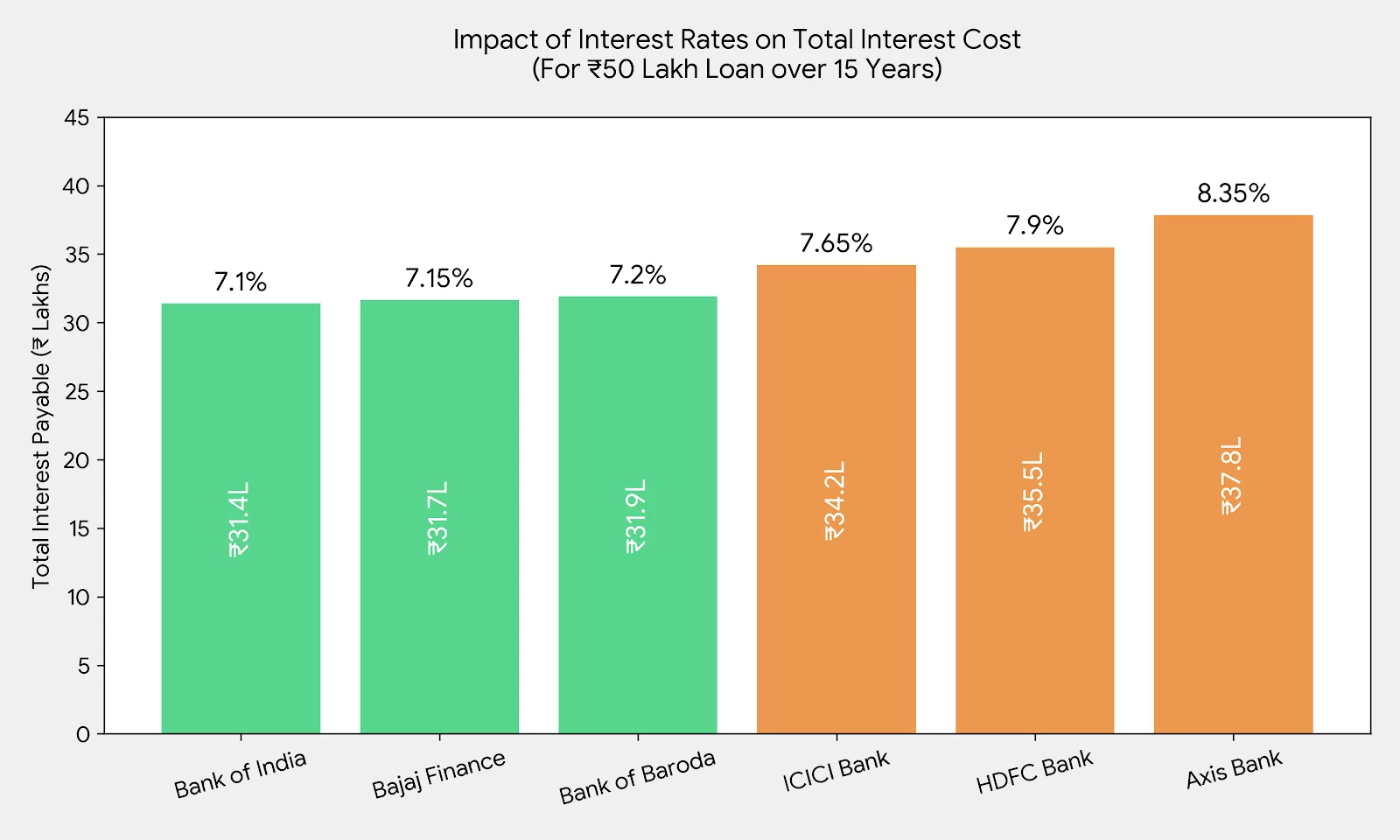
Home Loan EMI Example: Compare Total Repayment Across Leading Banks
Home loan interest rates vary across lenders. Even a slight difference in these rates can save big on borrowing costs. Let us understand this with an example.
Aman wanted to buy his dream home and was planning to borrow an amount of Rs. 50 lakh and repay it within 15 years. So he visited the TFS platform to compare interest rates and offers from various lenders. He shortlisted a few lenders and compared their EMIs and interest costs using a home loan EMI calculator. Post that, he selected the one offering the lowest borrowing cost. He was also eligible for a pre-approved home loan from HDFC Bank.
Let us see how the EMIs and total interest cost of the lenders he had opted for varied for different interest rates.
Also Read : CIBIL Score for Home Loan
Bank vs HFCs - Home Loan Interest Rates Comparison
- Public Sector Banks, generally, offer home loans at lowest interest rates
- Private Sector Banks offer home loans at relatively higher interest rates
- HFCs offer a relatively higher interest rate to borrowers
- As banks follow EBLR strictly, benefits of repo rate cuts are passed on to the borrowers quickly
- HFCs revise their interest rates at their own discretion and thus the impact on rates may take longer to reflect
- HFCs adhere to risk-based pricing strictly so the rates vary significantly for different applicants
- In long term, bank home loans are more economical whereas cost of loans for HFCs can be higher.
How RBI Repo Rate Changes Affect Housing Loan Interest Rates?
- RBI lends to bank at repo rates and any variation in this rate impacts the retail lending rates
- When RBI reduces the repo rate, banks also reduce home loan interest rates for floating-type home loans
- An increase in the repo rate increases the cost of borrowing for banks and thus home loan interest rates also increase for floating-type home loans
- Borrowers with fixed-rate home loans have almost no impact on their loan
- Home loan borrowers benefit from repo rate cuts if their loan is linked with repo rate or EBLR.
How to Get the Lowest Interest Rate for your Dream Home?
- To be eligible for the lowest home loan interest rates, follow these points closely
- Maintain a high credit score, preferably above 750 to be eligible for the best home loan offer
- Keep your EMI/MNI ratio low as lenders prefer borrowers having this ratio below 50-55% after loan sanctioning
- Compare home loan offers from multiple lenders before applying for one
- A higher down payment reduces the lender's risk so it can help get low rates
- A clean repayment record and stable income helps get a better loan offer
How Interest Rates Affect Your Home Loan EMIs?
Home Loan Interest rate is directly related to the EMI and interest cost. The higher the interest cost, the higher will be the EMI and interest cost. Thus, the overall borrowing cost incurred also increases. On the contrary, a low interest rate results in lower EMIs, lower interest cost and eventually reduced borrowing cost provided your loan amount and tenure remain the same.
Let's Take an Example: Rs. 20 Lakh Loan EMI at various Interest Rates
| Interest Rate (p.a.) | Loan Amount (Rs.) | Tenure (years) | EMI (Rs.) | Total Interest Cost (Rs.) |
|---|---|---|---|---|
| 7.10% | 20 lakh | 15 | 18,089 | 12,55,942 |
| 7.15% | 20 lakh | 15 | 18,145 | 12,66,047 |
| 7.90% | 20 lakh | 15 | 18,998 | 14,19,597 |
| 8.35% | 20 lakh | 15 | 19,519 | 15,13,480 |
| 8.50% | 20 lakh | 15 | 19,695 | 15,45,062 |
Also Read Home Loan EMI Calculator
How to Lower Your Interest Cost through Home Loan Balance Transfer
Home loan balance transfer allows you to reduce your total cost of home loan by transferring your outstanding loan to another lender offering a lower interest rate. A balance transfer makes sense in the early stages of the loan tenure and when the difference in interest rate is in the range of 0.75% to 1%.
You should analyse the savings and compare the cost of migrating to the new lender. HLBT is considered as a new loan by a lender so the processing fee and administrative charges may also incur. Thus, switch to a new lender only when the savings are significant and worth the effort.
Government & Affordable Housing Schemes with Special Rates
- Pradhan Mantri Awas Yojana (PMAY) offers subsidy to eligible borrowers effectively lowering the cost of loan.
- Affordable housing for women come with relatively lower interest rates
- Lenders offer special rates to borrowers who qualify for the EWS, LIG and MIG categories
- Subsidies provided by the government are credited directly to the lender reducing the principal and EMI burden for the borrower.